
A sales funnel is the path a stranger takes to become your customer, drawn as a funnel because fewer people reach each step than reached the one before. Most versions have four stages: someone becomes aware of you, gets interested, decides, and acts. Guides that list five or six stages are describing the same path cut into smaller pieces, or adding what happens after the sale.
This guide is for owners of service businesses, not sales teams. It covers the stages, why nobody agrees on how many there are, what the funnel looks like when your "sales team" is you and a phone, and two real funnels I built, taken apart step by step. Where a study says something, I link to it and say how old it is. Where I am giving my own opinion, I say so.
What is a sales funnel?
A sales funnel is a picture of how people become customers. Salesforce defines it as "the journey a prospect takes from awareness of a product or service to purchase" (Salesforce (opens in a new tab)). The funnel shape comes from the numbers: a hundred people might hear about you, ten might ask for a price, and three might hire you.
The word gets used for two different things, and it helps to keep them apart:
- The model: the stages a buyer goes through. Every business has this, whether or not anyone has drawn it.
- The thing you build: the pieces designed to move people from one stage to the next. Online that usually means ads or search results that bring people in, a page, a form, and then emails, text messages or calls that follow up. When someone sells you "a funnel," this is what they mean.
You already have the first kind. The question is whether anything is catching people as they move through it.
What are the stages of a sales funnel?
The four stages most guides start from are awareness, interest, decision and action:
- Awareness. Someone learns you exist. They saw your truck, a neighbor mentioned you, or you came up in a search.
- Interest. They look closer. They read your site, check your reviews, look at your photos.
- Decision. They compare you with the alternatives, including doing nothing. For a service, this is usually where a quote happens.
- Action. They book, sign or pay.
This model is old, and its history is shakier than most guides admit. It is usually credited to an advertising man named E. St. Elmo Lewis in 1898. The evidence for that is a 1925 textbook, which reports that Lewis taught the slogan "Attract attention, maintain interest, create desire" in a Philadelphia advertising course and "later on" added "get action" (Strong, The Psychology of Selling and Advertising, 1925 (opens in a new tab)). So the original had three steps and no funnel drawing. I mention it because the model is a teaching slogan that stuck, and nobody measured it into existence.
Is it four stages, five or six?
It is whichever number matches how your customers buy. Publishers pick different counts and different names, which is why searching this topic is confusing. Here is how the common versions line up:
| Model | Published by | Stages |
|---|---|---|
| Three stages | HubSpot (opens in a new tab) | Awareness, consideration, decision. Also called top, middle and bottom of the funnel |
| Four stages | The traditional version | Awareness, interest, decision (or desire), action |
| Five stages | Mailchimp (opens in a new tab) | Awareness, interest or consideration, desire, action, loyalty |
| Six stages | Salesforce (opens in a new tab) | Awareness and discovery, interest, consideration, intent, evaluation, purchase |
Two things explain almost every difference:
- Splitting the middle. The six-stage versions divide "decision" into consideration, intent and evaluation. That is useful if you have a sales team that hands a buyer from one person to the next. If you are the whole team, it is one stage.
- Adding what happens after the sale. Five-stage versions add loyalty: repeat work, reviews and referrals. That stage is not new either. The same 1925 textbook says a sales trainer, A. F. Sheldon, added "permanent satisfaction" to the formula "about 1907."
My opinion: for a service business, use four stages and add the after-sale stage. Your next customer often comes from your last one, so a funnel that stops at the invoice leaves out the part that feeds the top.
What does a sales funnel look like for a service business?
Most funnel guides describe an online store or a company with a sales department. A service business looks different: the "website visit" might be a phone call, and the "checkout" is a quote. Here is the same funnel in those terms.
| Stage | What the customer is doing | What catches them |
|---|---|---|
| Awareness | Searching "landscaper near me," asking a neighbor, noticing your sign | Your Google Business Profile, your reviews, word of mouth |
| Interest | Reading your site, looking at past work | A page for the exact service they need, with photos and prices or price ranges |
| Decision | Asking for a quote, usually from more than one company | A short form or a phone number, and a fast, clear reply |
| Action | Saying yes | A quote that is easy to accept, and a booking that is confirmed |
| After the sale | Living with the result | A check-in, a request for a review, a reminder when the next job is due |
The decision stage is where most service businesses lose people, for two documented reasons.
Buyers shop around. In a survey of more than 1,000 homeowners in late 2021, 95% said they get more than one bid for a job (ArcSite, January 2022 (opens in a new tab)). The survey comes from a company that sells estimating software and is several years old, so treat the exact figure loosely. The point holds either way: your quote is usually being read next to someone else's.
Businesses reply slowly, or never. The best-known study here is old, and I am quoting it with its age attached. In 2011, researchers writing in Harvard Business Review sent a test inquiry to 2,241 US companies. Thirty-seven percent replied within an hour, and 23% never replied at all (HBR, March 2011 (opens in a new tab)). A more recent test of one industry found much the same gap: when an agency sent inquiries to 1,333 US law firms in early 2025, 26% never answered within seven days (Hennessey Digital, 2025 (opens in a new tab)). I found no study like this of plumbers, landscapers or cleaners, so I will not give you a number for them. My opinion is that a small business has the advantage here: nobody has to route the inquiry to the right department, so answering within the hour is a habit, not a project.
The awareness stage for a local business is mostly local search, which I cover in my guide to local SEO.
Can you tell where your customers came from?
Online, mostly yes. Offline, mostly no, and that difference is the main practical advantage of a digital funnel.
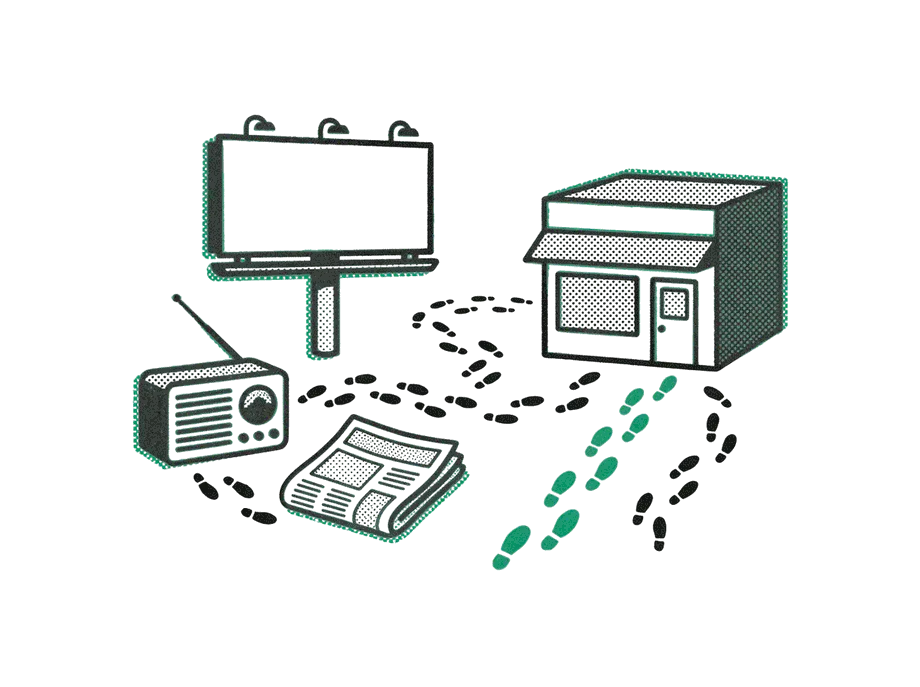
Each step of a digital funnel leaves a record. An ad click, a form, an email click and a booking can each be counted, and they can be tied to the same person. So you can see which ad or search brought someone in, how far they got and where they stopped.
Older kinds of advertising do not work that way. A billboard, a newspaper ad, a TV or radio spot, a podcast read or a sign on your truck can each put you in someone's mind, and none of them tells you it did. The person shows up later as a phone call or a search for your business name, and the channel that started it gets no credit. That does not mean those channels fail. It means you cannot easily tell which one is working, or which stage a person was at when it reached them.
A small business can close some of that gap without special software:
- Ask. Put "How did you hear about us?" on your form, and ask it on the phone. It is the oldest method and still the simplest.
- Give each ad its own way in. A web address, a phone number or an offer code used in one place only tells you where a response came from.
- Write the answer down next to the customer's name, so that at the end of the year you can count jobs by source, not just inquiries.
Treat the answers as a rough guide. People name the last thing they remember, which is often a search, when a neighbor's recommendation or a sign they passed for months did the earlier work. I looked for a solid study comparing what customers say with what tracking shows and did not find one I would quote, so this part is my own view: asked answers and tracked clicks each miss things, and the two together are better than either alone.
One caution if text messages are part of your follow-up. In the US, the Federal Communications Commission says a caller must "obtain your oral or written consent before making an autodialed or prerecorded call or text to your wireless number" (FCC (opens in a new tab)). The rules for marketing texts are stricter than the rules for email, so text only people who asked you to, and check the rules before you send in bulk.
What does a real funnel look like, step by step?
Here is one you can inspect. On my Sales Funnels page there is a free two-page guide called The Sales Funnel Map. Requesting it starts a funnel I built to teach funnels: ten emails over two and a half weeks that change course depending on what you do. Every email is published on the demo page, so you can read the whole thing without signing up.
I built it in seven parts. This is how those parts line up with the stages:
| Stage | Part | What happens |
|---|---|---|
| Interest | 1. The door | One page, one promise, one short form. It says exactly what you get for your email address |
| Interest | 2. The first reply | The guide arrives within seconds. The promise is kept before anything is sold |
| Interest | 3. The label | The system records what you asked for, so later emails can fit you |
| Decision | 4. The fork | The first email asks one question: do your leads go quiet, or do you need more of them? Your answer picks your path. There is a third path for people who do not answer |
| Decision | 5. The instant answer | Press a button and a reply written for your answer arrives in seconds |
| Decision | 6. The main road | The paths merge again, so there is one sequence to keep accurate, not three |
| Action | 7. The handoff and the exit | One email offers a call. If you take it, the automated emails stop and I take over. The last email removes you from the sequence |
Three decisions in it are worth copying, whatever tools you use:
- Keep the promise first. If someone asked for a guide or a quote, send that before any pitch.
- Ask one question that sorts people. Two customers with different problems should not get the same emails.
- Stop selling when someone says yes. A booked call should end the sales emails, because nobody wants a sales pitch after they have already raised their hand.
This funnel is a custom build: it reads replies, writes answers to a spreadsheet and offers a booking link. Most businesses need something simpler, and I say more about that under cost below.
What does a funnel look like for a real client?
Madison Media is a consultancy in Central Mississippi that helps small businesses and nonprofits make sense of AI. Its problem sat in the interest stage: a brochure site cannot prove that a consultant brings clarity. Visitors needed to feel the value before the first call.
So the site I built for them is organized around a quiz, the Friction Finder (case study). By stage:
- Interest: eight scored questions about what is slowing the visitor's business down.
- Decision: the score sorts each visitor into one of two types, and each type gets three next steps written for it.
- Action: every answer lands in the client's contact system and starts a series of eight follow-up emails written for that type.
It is the same pattern as my demo: one good question at the door, a label on the record, and follow-up that fits the answer. The site sorts its own leads, including the ones who arrive at 11 at night.
Is the funnel the right picture at all?
Not entirely, and the criticism is worth knowing. Real buyers do not move in a straight line.
In 2009, McKinsey studied the purchase decisions of almost 20,000 consumers and concluded that "the funnel concept fails to capture all the touch points" of modern buying. It proposed a circular journey in place of the funnel, with a "loyalty loop" for customers who come back (McKinsey, 2009 (opens in a new tab)). In 2020, Google's researchers described the stretch between first interest and purchase as a "messy middle," where people "loop through" exploring options and narrowing them down, and said that what happens there "is not linear" (Google, 2020 (opens in a new tab)). Neither study looked at local services, and Google sells advertising, so weigh them accordingly.
I agree with both, and I still use the funnel. McKinsey's own article says the metaphor helps by "highlighting the bottlenecks." That is its job. A funnel will not predict what any one customer does. It tells you which step is losing the most people, so you know what to fix first.
How do I build a sales funnel?
Draw it before you build anything. These are the eight lines from the worksheet on page two of my guide, and you can answer them on paper:
- The offer. What they get, in one sentence.
- The promise at the door. What arrives the moment they sign up or ask.
- The labels you will record. What they asked for, and which path they chose.
- The question that splits your buyers. One question, two or three answers.
- What each answer gets first. The first email or call on each path.
- What silence gets. The path for people who do not answer.
- The one action it ends in. A booked call, a purchase, an application.
- Who takes over, and how fast. The person, and the reply time you are promising.
Then build the smallest version: one page, one form, one automatic first reply, and three or four follow-up emails. A series of automatic emails like this is often called a drip campaign or a nurture sequence. A free offer in exchange for an email address, like my guide, is called a lead magnet.
Two rules apply once you are sending email, and neither is optional.
As of October 2026: In the US, the CAN-SPAM Act covers every commercial email, including business-to-business email. Your message must include your valid physical postal address and a way to opt out, and you must honor an opt-out within 10 business days. Penalties run up to $53,088 for each email that breaks the rules, and hiring someone else to send your email does not move the responsibility off you (FTC (opens in a new tab)). This is a summary, not legal advice.
The second rule is about honesty. A countdown timer that resets, or a "two spots left" that is always two, is what the Federal Trade Commission's staff call a dark pattern; their 2022 report lists the "baseless countdown timer" and the "false low stock message" by name (FTC, 2022 (opens in a new tab)). Real deadlines are fine. Invented ones are a good way to lose the trust the rest of the funnel worked for.
How do I track whether my funnel works?
Count how many people reach each stage, then divide. For a month, write down four numbers:
- people who visited the page, or called
- people who asked for a quote or signed up
- quotes you sent
- jobs you won
The share that moves from one step to the next is that step's conversion rate: conversions divided by visitors. Google's example is 50 conversions from 1,000 interactions, which is 5% (Google Ads Help (opens in a new tab)). Here is a made-up month for a landscaper, to show the arithmetic:
- 400 visits to the quote page and 20 quote requests: 5%.
- 20 requests and 16 quotes sent: 80%. Four people never got a quote.
- 16 quotes and 4 jobs: 25%.
Start with the cheapest leak, and in this example it is not the website. Four requests never got a quote, and answering them costs nothing. After that, the 25% is the number to work on: winning one more job in sixteen quotes would do more than a redesign of the quote page. The step to fix is rarely the one you expected before you counted.
On benchmarks, be careful. Unbounce reports a median conversion rate of 6.6% across more than 41,000 landing pages for the year ending July 2024 (Unbounce (opens in a new tab)). Those are pages built by its own customers for campaigns, and its method leaves out pages that converted nobody, so do not hold your home page to that number. Your own number last month is the better benchmark.
For the emails, watch clicks and replies, not opens. Apple's Mail app has a privacy feature that hides whether you really opened a message (Apple, 2021 (opens in a new tab)), and email providers say it "automatically marks emails sent to Apple Mail clients as opened." That quote is from MailerLite, whose figures for 2025, from more than 3.6 million campaigns, show a median open rate of 43.46% and a median click rate of 2.09% (MailerLite (opens in a new tab)). The click figure is the one to compare yourself with.
Clicks are not perfect either. When I tested my own demo funnel, a script opening a link was counted as a click within seconds, the way a company's mail filter would do it. That is why the demo asks you to press a button on a page before it changes your path: it is something only a person does.
How much does a sales funnel cost?
It can cost nothing but your time. A form on your site, an automatic reply and a spreadsheet of who asked for what is a funnel, and I would rather you had that than nothing.
If you hire it out, prices vary too widely for me to quote an average I can stand behind, so here are mine.
As of October 2026: I split funnels into two kinds. A simple funnel is one offer, its landing page and one email sequence of up to ten emails, plus up to two connected tools such as a booking link. Building one is a fixed-price project that I quote on a call, and running it afterward is $500 a month, with a lower rate for each additional funnel. A custom funnel, like the demo above, reacts to what people do and passes information between several tools; building one starts at $3,000 (Sales Funnels).
Whoever you hire, ask what the funnel ends in, how you will see the numbers for each step, and what happens to the emails when someone books. For the cost of the site a funnel sits on, see my breakdown of website costs.
What is the difference between a sales funnel and a marketing funnel?
In a company with separate departments, the marketing funnel covers everything up to the moment someone becomes a lead, and the sales funnel, in Salesforce's words, "picks up from here, focusing on the journey to final purchase." A sales pipeline is the same path seen from the seller's side: a list of your open deals and what you need to do next on each.
If you are a small business, these are one funnel with one owner. Do not let the vocabulary make it sound bigger than it is.
The short version
A sales funnel has four stages: awareness, interest, decision and action, plus what happens after the sale. Five-stage and six-stage versions cut the same path into smaller pieces. For a service business, the stages are a search or a referral, a look at your site, a quote, a yes, and a review. Draw yours on paper before you build anything, keep your promise before you pitch, ask one question that sorts your buyers, reply fast, ask every customer how they found you, and stop selling when someone says yes. Then count how many people reach each step, and fix the cheapest leak first.