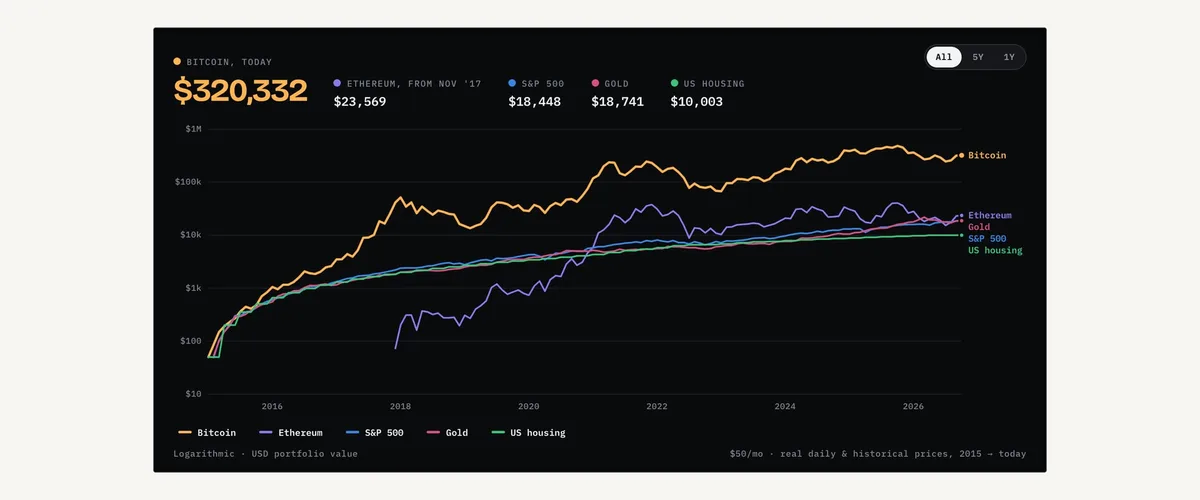
Every Bitcoin calculator on the internet answers the same narrow question: what would Bitcoin have done? They show Bitcoin against Bitcoin, which tells you nothing about whether the money would have been better off somewhere else.
The comparison people actually want — Bitcoin against gold, against the S&P, against the house they didn't buy — is the one nobody builds, because those assets don't share a unit. You can't buy a corner of a house each week the way you can buy a fraction of a coin.
03
How It Works
What shipped
BTC DCA Engine funds 22 dissimilar assets with an identical schedule of buys, then reads the difference in plain dollars.
The move is to stop thinking in shares and start thinking in units. Every contribution buys a fractional unit — dollars divided by that day's price. Multiply accumulated units by today's price and you have today's value, always denominated in dollars. The same arithmetic runs for Bitcoin, gold, an index and a housing series alike, so they finally share one logarithmic axis.
The simulator runs on real daily prices back to 2015, and every run produces a shareable link that reproduces the exact result against the same data. It is free to use, with a Pro tier that adds inflation-adjusted returns, risk metrics and up to five strategies side by side.
The engine is also listed in ChatGPT's plugin directory (opens in a new tab). Behind the listing is an MCP server I built, a connection that lets AI assistants run the simulator themselves, and the same server already works in Claude and other AI tools. Ask ChatGPT in plain words what $50 a week into Bitcoin since 2018 would be worth today, and the figure comes from the engine rather than a guess, with a link that opens that exact run in the simulator.