

Google Guaranteed no longer exists. On October 20, 2025, Google replaced it, along with Google Screened and License Verified by Google, with a single badge called Google Verified, and it ended the money-back guarantee that came with the old badge. What is left is the ad program the badge always belonged to, Local Services Ads: the listings at the top of a Google search where a business pays for each lead instead of each click. And since October 1, 2026, a call you miss during your business hours can count as one of those paid leads.
So the real question for a contractor today is not how to get Google Guaranteed. It is whether Local Services Ads are worth paying for when an unanswered call can cost you a lead fee and the job. My short answer: yes, if someone answers your phone during the hours you set; no, if most calls go to voicemail while you are on a job. A disclosure: I sell a service that answers missed calls by text, and I manage paid ads, so I have a bias. If someone in your office picks up every call during your hours, you may not need me or anything like it. Where a figure comes from a source, I link it with its date; where I give my opinion, I say so.
Is Google Guaranteed still a thing?
No. Google announced the change in August 2025: "Google Verified will replace other LSA badges and programs, like Google Guaranteed, Google Screened, License Verified by Google and the Money Back Guarantee" (Google, August 20, 2025 (opens in a new tab)). The switch took effect on October 20, 2025 (Search Engine Roundtable, August 21, 2025 (opens in a new tab)).
The money-back guarantee went with it. Google's help page says it "will be discontinuing the Money Back Guarantee associated with the Google Guarantee badge," and that "eligible consumers can submit the request for reimbursement for services booked through Local Services Ads before December 7, 2025," within 30 days of the job being finished (Google, About Google Verified badge (opens in a new tab)). A job booked through an ad today carries no refund from Google.
Google's help page says both things in its own words: the guarantee is discontinued, and only jobs booked before December 7, 2025 could be claimed.
Most of what you will read about Google Guaranteed has not caught up. Of the four guides from other publishers on the first page of results that I read on October 30, 2026, none mentions Google Verified, and three still describe a refund of up to $2,000 as if it were current. Even Google's own article on the subject, which still ranks on that page, says the badge "also assures their satisfaction by offering a money-back guarantee" (Google Ads, "How to build trust online with the Google Guarantee" (opens in a new tab), last modified June 2025). If a salesperson pitches you "Google Guaranteed" today, ask them what they mean by it.
The same goes for Google Screened, the old badge for professional services such as lawyers and real estate agents. It was retired on the same day, under the same single badge.
What is Google Verified, and how do you get it?
Google Verified is the badge that now appears on a Local Services Ads profile once a business has passed Google's screening. It shows next to the checks the business passed, such as a license or a background check. Unlike the old badge, it does not promise the customer anything if the job goes wrong.
You get it by signing up for Local Services Ads and passing the checks for your trade and state. There is no separate application for the badge. Google lists what the checks can include (Google, Business screening and verification requirements (opens in a new tab)):
- A verified Google Business Profile. Every advertiser needs one, and the person doing the sign-up must be an owner or manager of the profile. My guide to Google Business Profile optimization covers setting one up.
- Background checks. Google calls HVAC, plumbing and electrical "urgent" categories, because people call those trades for things like a broken heater in freezing weather, so they get "an additional level of screening, which includes service professional background checks." In those categories every worker who goes into a customer's home is checked, not just the owner. The checks are free to the business and do not include a credit check (Google, Understand the screening and verification process (opens in a new tab)).
- License, insurance and business registration checks. Google lists them for most trades, marked "Select users only", so not every business is asked for every one.
Plan for it to take a while. Google says the process takes three to four weeks on average once your documents are in. Some businesses qualify for accelerated verification and get the badge quickly, then have 14 days to finish the remaining steps. A business that fails a background check waits 30 days to reapply after a final decision, and 180 days after a second denial.
How do Local Services Ads work?
Local Services Ads are the listings Google shows at the top of some local searches, such as "plumber near me", on Search and on Maps. Each shows the business name, its rating and reviews and, if it has passed screening, the Google Verified badge. The customer can call, send a message or, in some cases, book from the ad.
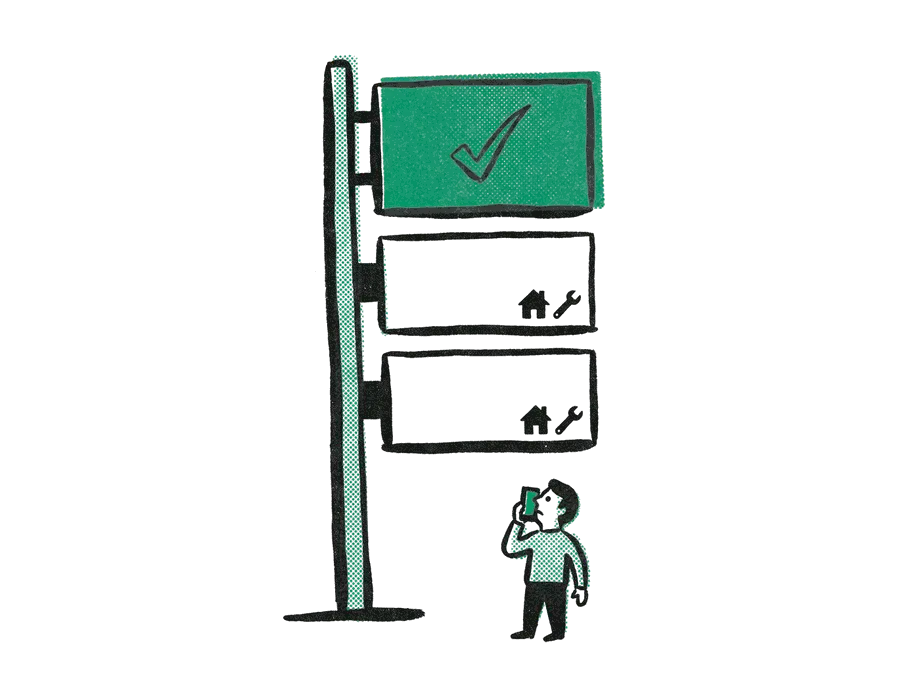
Three things make them different from ordinary Google ads:
- You pay per lead, not per click. A lead is a call, a message or a booking request that Google judges to be real and related to your business. Google says "lead prices may vary depending on your location, the job type, the type of lead, or your bidding mode" (Google, How leads work (opens in a new tab)). You set an average weekly budget, and Google never charges more than your monthly maximum.
- There are no keywords. You pick your trade, the jobs you do and the areas you serve. Google decides which searches you show for.
- Your ranking depends on more than your bid. Google lists your bid, what and where the customer searched, your rating and number of reviews, your average response time, your photos, the checks you have passed, and how responsive you are. On responsiveness, it says plainly: "Missed calls may negatively affect your responsiveness" (Google, About ad rankings (opens in a new tab)).
Google also checks leads after the fact. A lead it later judges to be spam, a duplicate or poor quality is credited back to your account within 30 days, and you can flag a bad lead yourself through the feedback survey for that lead. That last part changes once your account moves into Google Ads, which I cover below: you can no longer dispute a lead.
Which missed calls do you pay for now?
Since October 1, 2026, an unanswered call can be a paid lead. Google first told advertisers by email in August (Search Engine Roundtable, August 25, 2026 (opens in a new tab)), and its help page now lists this among the ways a valid lead is created: "You missed a phone call during your business hours and the customer stays on the line for more than 20 seconds" (Google, How leads work (opens in a new tab)).
Google's list of valid leads puts the missed call second, right after a call you answer.
The detail that will surprise most owners is voicemail. Google treats a call that reaches your voicemail during business hours as a connected call: "If a call goes to voicemail or an automated greeting during your business hours, it's treated as a connected call and is charged if the caller stays on the line for more than 20 seconds, whether or not they leave a message." For a contractor on a roof, that is most missed calls.
| What happens to the call | Charged? |
|---|---|
| You or your staff answer it | Judged as an answered call, on the conversation |
| You miss it during business hours and the caller stays on for more than 20 seconds | Yes |
| It goes to voicemail during business hours and the caller stays on for more than 20 seconds, with or without a message | Yes |
| Your phone menu asks the caller to press a key, and they hang up without pressing one | No |
| The caller presses a key, then stays on for more than 20 seconds | Yes |
| The same customer calls or messages again within 15 days | No, not again |
| You miss it outside your business hours or your ad schedule | No |
"Business hours" here means the hours on your Google Business Profile. If you set an ad schedule that differs from them, an unanswered call is only charged when it falls inside both. That makes your profile's hours a billing setting, not just a courtesy to customers.
The hours on my own Business Profile are where I would start checking.
How much do Local Services Ads cost?
Google does not publish lead prices. They vary by trade, by town and by the kind of lead, and Google sets most of them through its bidding. The figures I could find come from agencies that run these ads for clients.
The clearest set comes from The Media Captain, an ad agency, which published its average cost per lead across more than 100 of its clients in August 2025. For the trades it lists, from roofers down:
The numbers
| Trade | Average cost per lead |
|---|---|
| Roofer | $162 |
| HVAC | $80 |
| Fencing | $71 |
| Plumbing | $69 |
| Painter | $40 |
| Landscaper | $39 |
| Drywall repair (handyperson) | $34 |
| Locksmith | $34 |
Read those as a rough guide, not a quote. They are one agency's clients, the page does not say how many accounts are in each trade or which months it covers, and they are from before the missed-call rule. The same page says "Businesses typically receive 6-7% of their LSA spend back in credits for unqualified leads," and that more than 90% of its clients' leads came by phone rather than a form.
Here is why that 90% matters now. As an example, if an HVAC lead costs about $80 and you miss five calls a week during your hours that each ring past 20 seconds, that is about $400 a week in lead fees for customers nobody spoke to. Those numbers are my illustration, not a measurement; put your own lead price and your own missed calls in their place. The second cost is bigger: the customer who reached your voicemail usually calls the next company on the list, a problem I cover in my guide to speed to lead.
Local Services Ads vs Google Ads: which should you use?
They answer different searches and charge for different things. Ordinary Google search ads charge for each click, run on keywords you choose, and send people to your website. Local Services Ads charge for each lead, choose the searches for you, and send people straight to your phone.
| Local Services Ads | Google search ads | |
|---|---|---|
| You pay for | Each valid call, message or booking | Each click |
| Targeting | Your trade, jobs and service area | Keywords you choose |
| Where it sends the customer | Your phone or Google's message inbox | Your website |
| Badge | Google Verified, after screening | None |
| Who can use it | Eligible trades and services only | Almost any business |
| Your control | Budget, service area, schedule | Keywords, ads, bids, landing pages |
My opinion: for a trade that qualifies, Local Services Ads are the easier start, because you are not paying for clicks from people who never call. Search ads earn their place when you want to choose the jobs you advertise, or send people to a page that sells a particular service.
The line between the two is blurring. Google is moving Local Services Ads into the main Google Ads platform as a special kind of Performance Max campaign with "pay-per-lead goals." The first phase began in August 2026 with select US home-service advertisers, plumbing, HVAC, electrical and roofing among them, and the rest follow through 2027 (Google Ads Help, "Local Services Ads transition to Performance Max campaigns with pay-per-lead goals" (opens in a new tab)). Google says your ads keep showing in the same places and you still pay per lead. Five things change for you:
- Your old reports do not move. Google says "Your Local Services Ads performance reports won't transition to Google Ads." Screenshot them before your account moves (Google says a download is coming); Google emails the account's administrator 14 days ahead.
- You can no longer dispute a lead. Google's page for the move says it plainly: "Manual lead disputes are no longer supported." Its systems now find invalid leads, such as spam, wrong numbers and repeat callers, and remove the charge on their own. You can still rate a bad lead from the Leads page, but Google says that "initiates an automated evaluation" rather than a dispute (Google Ads Help, "Lead quality and budgets for campaigns with pay-per-lead goals" (opens in a new tab)). If an automated check gets a lead wrong, there is no longer a dispute to file, so watch each lead's charge status.
- Manual bidding ends. You can no longer set a maximum price per lead yourself. If you run plumbing and HVAC in one campaign, they share one target cost, so split them into separate campaigns if their lead values differ.
- Budgets become daily. Your weekly budget is divided by seven. The monthly cap stays about the same.
- Your business hours come from your Business Profile. Name, address and hours sync one way from your profile into Google Ads, which ties back to the missed-call rule above.
Are Local Services Ads worth it?
My opinion, for a contractor deciding this month: they are worth testing if you can say yes to most of these, and probably not if you cannot.

- Someone answers the phone during the hours on your profile. This is the big one since October. If you work alone and your phone goes to voicemail while you are on a job, you are paying for those calls.
- Your reviews are as good as your competitors'. The ad shows your rating next to everyone else's.
- A job is worth many times a lead. As a rough example, if a typical job brings in $300 of profit and a lead costs $75, you break even by winning one lead in four. Use your own numbers.
- You can reply to messages quickly. Message leads count too, and Google measures your response time.
- You will check your charges. Look at each lead's charge status every week, and flag the ones that were spam or the wrong job. Once your account has moved into Google Ads, flagging a lead starts Google's automated check, not a dispute.
If you are already running them, three changes cost nothing:
- Set your profile's hours to the hours someone actually answers. If nobody picks up after 4 PM, do not list 6 PM.
- Use an ad schedule that ends when your answering does.
- Turn on message leads, so a customer who would rather type has a way to reach you that does not depend on you picking up.
If your phone is the problem, fix that before you buy more leads. A missed call that gets an instant text back still has a chance; a missed call that reaches voicemail has cost you the fee and probably the job. For what it takes to answer every lead quickly, see speed to lead; for the rest of a contractor's local presence, my guide to local SEO for small businesses.
The short version
Google Guaranteed ended on October 20, 2025. Google Verified replaced it, and it comes with no money-back guarantee. What remains is Local Services Ads: pay-per-lead listings at the top of Google, with screening that takes about three to four weeks. Since October 1, 2026, you also pay for missed calls during your business hours, voicemail included, once the caller stays on past 20 seconds, and your Google Business Profile's hours decide what counts as business hours. Lead prices are not published; one agency's 2025 averages ran from about $34 to $162 for the trades. They are worth it if someone answers your phone during the hours you list, and an expensive way to fund your competitors if nobody does.